
Strategy isn’t like a GPS. You can’t just enter a destination and follow the route. In an unpredictable world, strategy requires learning a different skill — drawing the map on the go to find the best way forward.
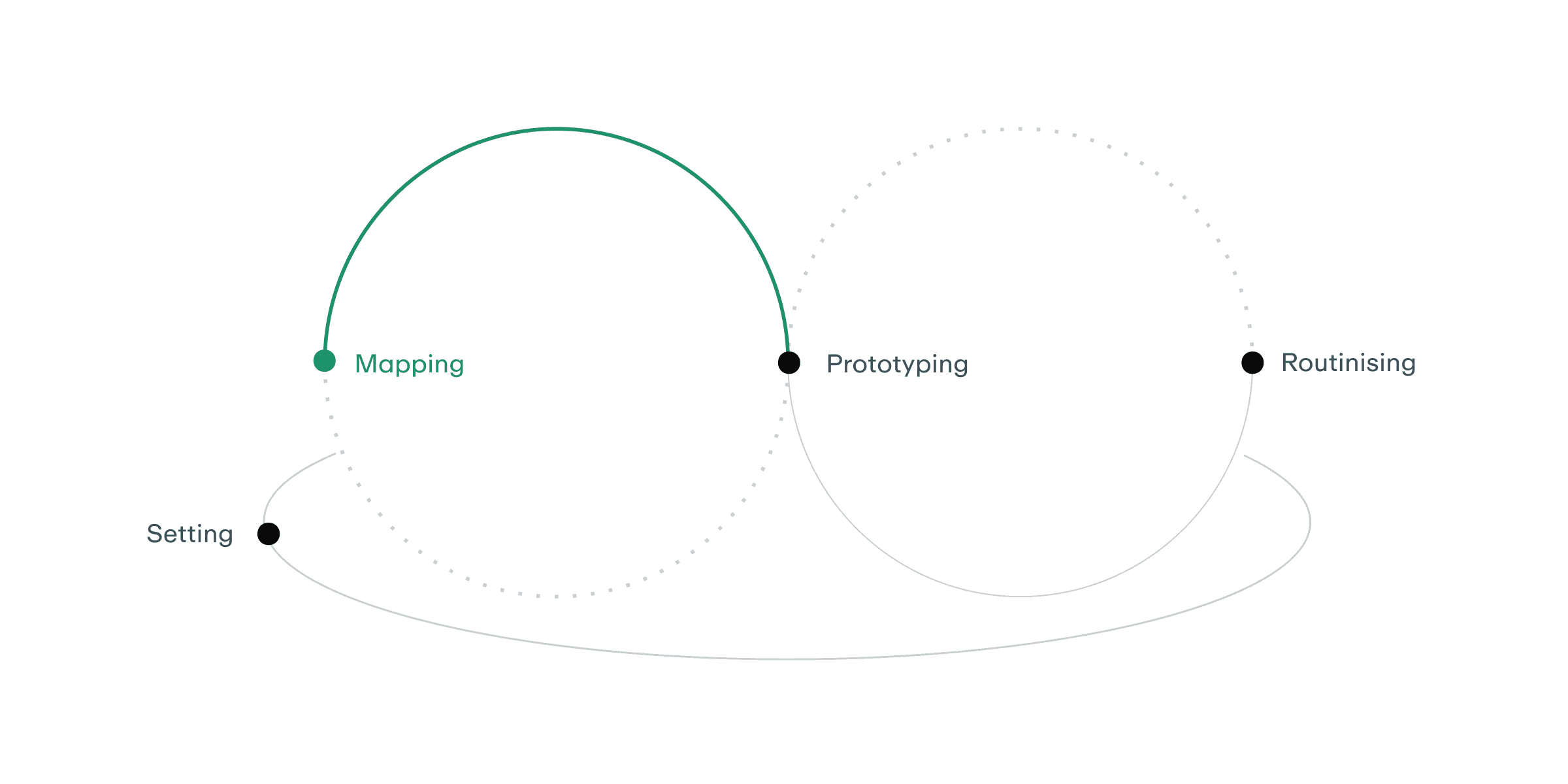
© For Planet Stratey Lab Process Model - Mapping, 2026
Don't just follow a map - create one yourself
A fundamental error in strategy is to think that your strategy is a precise plan that shows you where your organisation needs to go. This might work in a stable and predictable world that you can navigate by simply following clear directions. However, today's world is constantly changing, increasingly complex and unpredictable. Fixed directions no longer apply.
A map shows you where to go when the world is stable. Mapping is a skill that allows you to find your way when it is not.
As strategists, your role is not just to read an existing map, but to draw the map yourself as you head into the unknown. Setting the destination simply by defining a company vision or mission is not enough. Like early explorers, you don’t always know the destination when you set out. By shifting from a static map to dynamic mapping, you build the collective skill of how to find direction in an unstable world.
Learn to find your way in a complex world by strategy mapping
At For Planet Strategy Lab, mapping is a key element of our strategy processes to help you orient yourself in an unpredictable world.
Connect perspectives to avoid blind spots
You don’t create value on your own, you co-create it with others. That’s why a key element of mapping is learning to make sense of others’ perspectives: your colleagues, employees, customers, competitors - and even non-human actors (like AI agents, viruses, or regulations). Such a collective process also helps you to prevent blind spots. The trick is to not simply aggregate these actors, but to put them in relation to each other, triggering a negotiation process of what is and what is not included in the map.
From data to insight: the power of synthesising information
We have more information available at a click than we know what to do with. The challenge isn’t to collect more and more of it, but to synthesise it. We need to research what is going on in the world, looking for trends and also weak signals that are indications of what will become important. But crucially, research also means making judgement calls about what is really important in your context.

A useful map doesn’t show everything, but highlights a selection of available information that is relevant. A good subway map doesn’t detail the entire city, but synthesises and abstracts only the subway routes and stops.
Opportunities are created, not found
Mapping creates a shared understanding of your organisation's inner and outer workings, its relationships, and how value is created. This is not only an analytical, but a collective and creative process. Building this foundation allows your team to cut through complexity and ask the questions that identify the issues that matter most. They are the crucial leverage points and tensions that ensure your offering remains future-proof and sustainable over the long term. Doing so shifts your strategy process from merely reacting to circumstances, to proactively creating opportunities.
Focus on what matters – and what doesn’t
Strategy is not only about deciding what to do, but also what not to do. That’s often the hardest part, in strategy work more broadly and in mapping. You need to exclude what is not relevant to create clarity and direction.
This becomes easier as you learn how to set a clearer focus. Such a focus is like a compass that lets you know if you’re headed north or south. Without a compass, even a great map is useless.
In our strategy projects, we work with you to create settings where you can make the bold decisions necessary to orient yourself in your ecosystem and focus on what matters.
Mapping is the foundation of effective strategy work
In unpredictable, unstable contexts, strategy begins with mapping: learning to identify what is relevant in your organisation’s environment for its future success through:
Connecting perspectives
Synthesizing information
Creating opportunities
Focussing on what matters
At For Planet Strategy Lab, we see this as a collective sensemaking process rather than an individual analytical skill. Combining this collective sensemaking with bold decisions lays the foundation for forward-looking strategy work.
Further Inspirations
Chia, R. C., & Holt, R. (2009). Strategy without design: The silent efficacy of indirect action. Cambridge University Press.
Latour, B. (1999). Pandora’s hope: Essays on the reality of science studies. Harvard University Press.
Sarasvathy, S. D. (2001). Causation and effectuation: Toward a theoretical shift from economic inevitability to entrepreneurial contingency. Academy of management Review, 26(2), 243-263.
Weick, K. E. (1995). Sensemaking in Organizations. Thousand Oaks, CA: Sage.