
In a world where answers, images and entire applications are just a few prompts away, it can feel like process is obsolete. Trust the process turns into skip the process.
Why process matters more than ever
This view, however, stems from a limited understanding of what process is. It sees process as a set of clearly defined tasks in the form of recipes that structure daily work. Such an approach is bound to fail once organisations move into uncertain territories – and this is exactly what is happening today: From the digital transformation to geopolitical shifts, the context of organisations is changing faster than ever. Fixed processes no longer apply.
So why do we claim that processes matter more than ever? The key is understanding that processes are much more than a fixed recipe. They are powerful guidelines that allow us to handle an increasing amount of complexity and interdependencies not just as individuals, but together as a group. We need dynamic processes that go beyond preserving the past towards opening up alternative futures today.
Evolutionary processes go beyond mere retention
Nature’s evolution shows us that the most adaptive and thus successful processes involve variation, selection, and retention. Variation enables differentiation, selection leads to focus, and retention ensures stability. Successful evolution depends on recurrently creating a variety of options, selecting the most promising ones, and retaining them.
Yet most organisational processes we encounter today are out of balance. They focus mainly on retention – optimising and protecting what already works while unable to engage with what is emerging. It’s the classic innovator’s dilemma, where past success becomes the biggest obstacle to an organisation’s serious engagement with promising opportunities.
Strategy is an evolving process, not a fixed template
The same is true for strategy. While many organisations claim to have a strategy process, their strategies take the form of fixed recipes. These strategies prescribe the what in the form of goals and ambitions, instead of shaping the how as an evolving direction moving forward.
It is no surprise that organisations with template-driven strategies fail in the very moment they hit the ground. Instead of empowering organisation members to learn from their context and develop fitting responses, they provide a false sense of control and delay action.
With a static strategy, organisations may survive, but can’t thrive. All too often, strategy documents end up in the drawer once approved by the executive board as they are no longer relevant for the ever-evolving context. Strategy fails to come alive across the organisation.
At For Planet Strategy Lab, we have the ambition to change this. We craft living strategies that evolve with their context to achieve unique positioning, build differentiating capabilities and sustain future value creation. Such strategies come to life through a process that builds an organisation's capability to learn, engage, and commit in context.
The FPSL process – Bringing strategies to life with mapping, prototyping and routinising
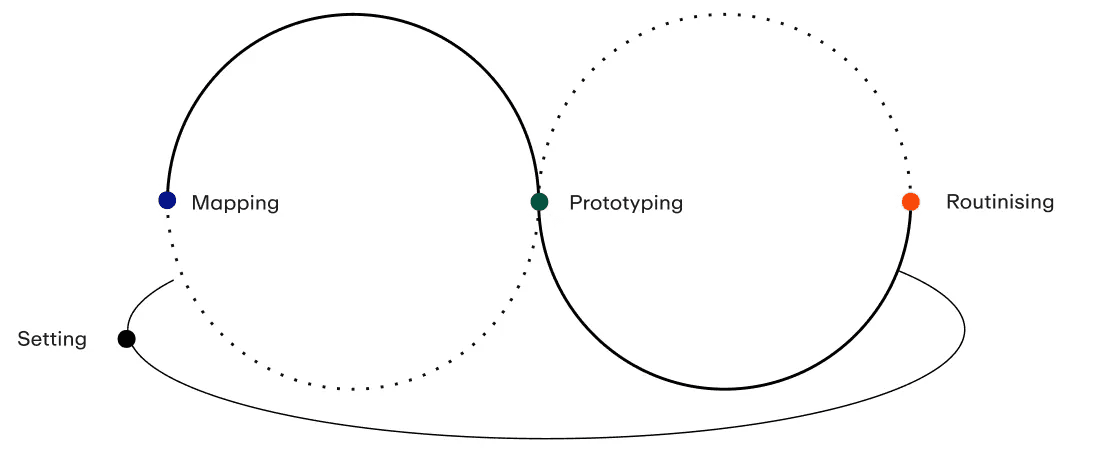
© For Planet Strategy Lab AG, 2026, Process Model
As part of constantly refining our way of working, we have condensed our extensive academic research and the learnings from hands-on practice into a simple but elegant strategy process. It guides our partners and us not only in crafting new strategies, but also in sustaining and evolving them.
The For Planet Strategy Lab process defines, connects and balances four practices that are at the core of an organisation’s capability to bring strategies to life collectively. They deliberately connect individual work to the organisational level, ensuring broadly-supported learning, collaboration and commitment.
Setting – More than a one-time kick-off, Setting is an ongoing effort to ensure the right conditions for strategy work – shaping spaces, empowering people, and curating leadership. Together, we identify who forms the entrepreneurial core that drives strategy work across the organisation.
Mapping – Going beyond traditional analysis, we create shared maps that deconstruct the complex challenges and interdependencies an organisation faces. This allows us to truly understand how an organisation creates value today and to identify promising ways to evolve this in the future. → more on Mapping
Prototyping – We don’t just develop strategic options, but translate them into tangible strategy prototypes that are tested internally and externally. With our hypothesis-driven approach to strategy prototyping, we turn abstract ideas into projects, products and narratives, allowing us to define precise hypotheses, create resonance, and generate unique insights.
Routinising – Instead of mere implementation, we design customised organisational routines that sustain your strategic momentum in the long run. Moving from static deliverables to dynamic routines empowers teams across the board to think and act entrepreneurially. → more on Routinising
Together, these four practices form the FPSL process. It is not a step-by-step recipe. Whether you start with Mapping or dive straight into Routinising is up to the specific challenge at hand. The world is uncertain. But having a clear process allows us to navigate this uncertainty and turn it into promising opportunities for value creation.
Further Inspirations
Burgelman, R. A., Floyd, S. W., Laamanen, T., Mantere, S., Vaara, E., & Whittington, R. (2018). Strategy processes and practices: Dialogues and intersections. Strategic Management Journal, 39(3), 531–558.
Christensen, C. M., & Raynor, M. E. (2003). The innovator’s solution: Creating and sustaining successful growth. Harvard Business School Press.
Feldman, M. S. (2016). Making Process Visible: Alternatives to Boxes and Arrows. In A. Langley & H. Tsoukas, The SAGE Handbook of Process Organization Studies (pp. 625–635). SAGE Publications Ltd.
Rüegg-Stürm, J., & Grand, S. (2019). Das St. Galler Management-Modell. Haupt.
Van de Ven, A. H., & Poole, M. S. (1995). “Explaining Development and Change in Organizations.” Academy of Management Review 20(3), 510–540